This independently written summary is based on a manufacturer-reported project published by PQWT. The project outcome is attributed to that source; geology, pipe conditions and operator technique vary, so this case is not a performance guarantee.
Manufacturer case material published November 25, 2025: Ghana Client Uses the PQWT-L40 to Locate Underground Pipe LeaksResidential leakage and the need to limit excavation
The manufacturer report places the project in a residential area where underground pipe leakage was disrupting normal water service and wasting water. The operational challenge was to move from a general symptom to a defensible repair zone without opening a large area of ground.
For this type of job, the pipe route, material, pressure, valves and background noise strongly affect the acoustic result. A detector is most useful when it is part of a staged workflow: confirm abnormal loss, identify the affected section, compare signals along the route and verify the strongest zone.
How acoustic comparison would narrow the leak
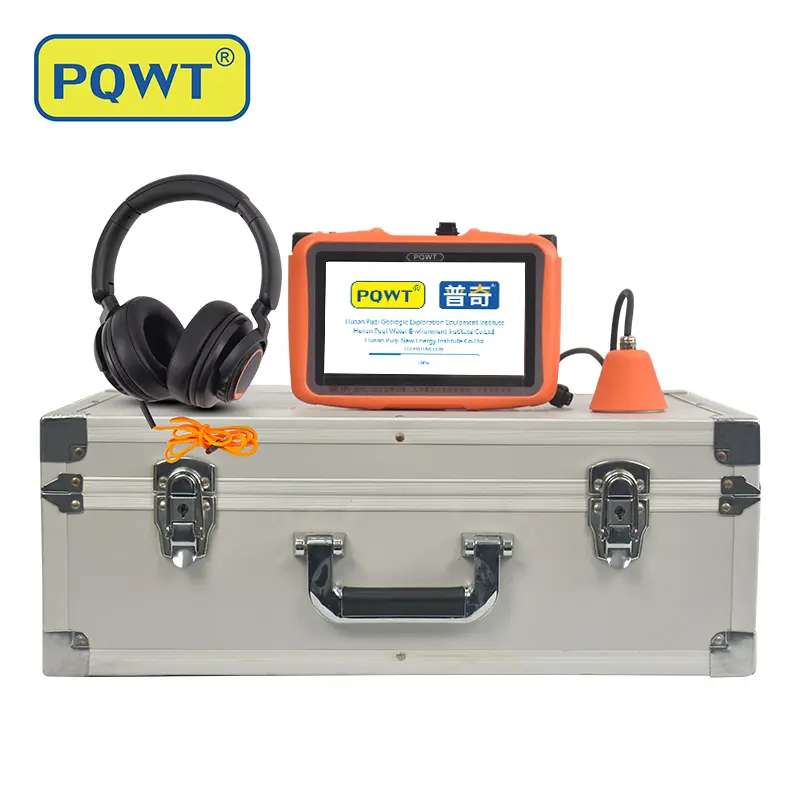
The source says the customer used the PQWT-L40 to locate the source of the underground leak and then completed the repair. The L40 is presented as an acoustic instrument: its sensor captures vibration associated with pressurized leakage, while headphones and visual information help the operator compare locations.
A disciplined field interpretation does not rely on one loud point. Accessible fittings are screened first to identify the stronger section. Ground measurements are then taken at consistent spacing above the mapped route. The suspected peak is bracketed from both directions and rechecked when noise conditions change.
Confirm abnormal loss
Use meter flow, pressure behavior or consumption records to establish that a hidden leak is likely.
Map the pipe route
Identify valves, branches, service connections, material, depth and the surface above the pipe.
Screen accessible points
Compare valves, meters and fittings to narrow the part of the network carrying the strongest stable signal.
Ground-listen systematically
Use consistent spacing, sensor contact, gain and filters while recording each point.
Bracket and verify
Measure beyond the strongest zone and repeat before marking a controlled repair area.
The repair outcome reported by the manufacturer
The source reports that the customer located the leak source and repaired the affected pipe without the broad trial excavation associated with less targeted work. It also claims substantial time savings, but it does not publish timestamps or a comparison log, so this summary does not repeat a numerical saving as independently verified.
A stronger closeout record would show the pre-repair meter or pressure evidence, the final acoustic point map, photographs of the exposed failure and the same measurements after repair. That proves both that the marked zone was correct and that the repaired defect was responsible for the original loss.
What a Ghanaian utility or contractor should document
- Record pipe material, diameter, estimated depth, operating pressure and surface type.
- Sketch the route, branches, valves and every listening point before interpreting the peak.
- Measure at quiet times and note pumps, traffic, electrical equipment and water use.
- Keep gain and frequency settings unchanged while comparing adjacent points.
- Use a second method when pipe material or site noise makes the acoustic peak uncertain.
- Repeat meter, flow, pressure and acoustic checks after repair to confirm closure.
Practical lessons from the reported project
Map before listening
A strong signal is not useful if it is compared against the wrong buried route or an unknown branch.
Compare, do not chase volume
Tone, stability, position and repeatability matter more than one maximum number on the display.
Bracket the repair zone
Measurements on both sides of a suspected peak reduce the risk of stopping at the first convincing point.
Close the evidence loop
Post-repair flow, pressure and acoustic checks show whether the detected defect actually caused the loss.
Related equipment
Frequently asked questions
Can the L40 locate every underground pipe leak?+
No. Acoustic performance depends on pipe material, pressure, leak size, depth, soil, surface and background noise. Difficult sites may need tracer gas, correlation or isolation testing.
Does the Ghana case prove a fixed time saving?+
The manufacturer reports a substantial saving, but the public case does not provide a timed comparison. This page therefore treats the benefit as source-reported rather than independently measured.
Is the loudest signal always the leak point?+
No. Valves, pumps, surface coupling and other noise can create strong readings. Measure past the peak, repeat and verify the pipe route before excavation.
What is the best method for plastic pipe?+
Acoustic testing can work, but plastic often dampens vibration. Use closer spacing and suitable frequency bands; consider tracer gas or another method if the signal remains weak.
PROJECT REVIEW & MODEL SELECTION
Need to locate a buried pipe leak?
Send the pipe material, diameter, pressure, estimated depth, route length, surface and symptoms. We can compare the L40 with indoor/outdoor acoustic and tracer-gas configurations.