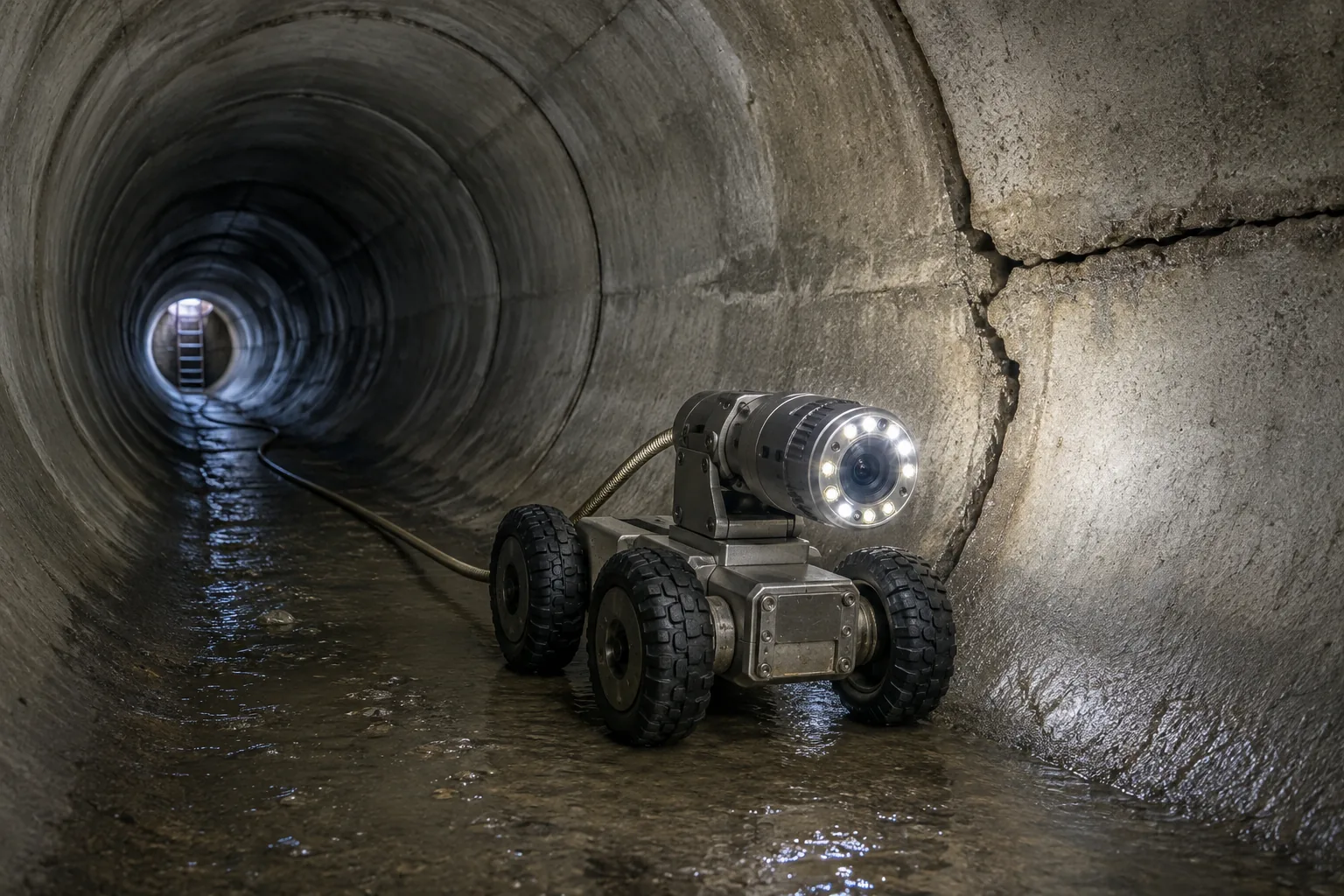
Choose a CCTV pipeline inspection robot from the minimum and maximum pipe diameter, water and silt conditions, bends and steps, required travel distance, camera viewing direction, cable-reel workflow and reporting needs. A compact front-view crawler is suitable for smaller straight pipes; larger municipal work may require adjustable or dual cameras, multiple wheel sizes, stronger obstacle crossing and electronic distance recording. Confirm the exact configuration in the quotation before ordering.
A CCTV pipeline inspection robot lets an operator examine drainage pipes, sewers, culverts and other confined underground spaces from a safer position above ground. Live video helps document cracks, displaced joints, roots, sediment, corrosion, deformation, foreign objects and other visible conditions before cleaning, repair or rehabilitation.
The best robot is not automatically the largest or most expensive model. It is the configuration that can physically enter the pipe, keep the camera stable, pass the expected obstacles, return safely and produce the records required by the customer or engineering team.
Where is a pipeline inspection robot used?
Sewer and drainage networks
Inspect main lines, service connections, manholes and rehabilitation sections before planning cleaning or repair.
Process and utility pipelines
Document visible internal condition where diameter, access, atmosphere and contamination controls permit crawler use.
Culverts and underground passages
Review joints, deformation, sediment, standing water and obstructions without sending a person into the space.
Acceptance and handover checks
Record post-installation condition, alignment and visible defects before a new or repaired section is accepted.
Pre-cleaning and post-cleaning surveys
Compare the pipe before and after jetting, dredging or blockage removal and preserve video evidence.
Targeted defect confirmation
Locate the visible section requiring excavation, lining, joint repair or further engineering assessment.
Seven factors that determine the right inspection robot
- Pipe diameter: check the smallest internal diameter, not only the nominal size. Allow clearance for joints, deformation, deposits and the selected wheel set.
- Pipe condition: report standing water, silt, grease, roots, steps, bends, steep gradients and suspected collapse before selecting the crawler.
- Camera requirement: choose fixed front view for simple screening, or adjustable and dual-camera systems when the operator needs a wider or more controllable view.
- Image and lighting: resolution matters, but stable focus, suitable LED illumination and a clean lens often have greater impact on usable inspection evidence.
- Travel distance: confirm the supplied cable length, distance counter, reel type and the safe retrieval plan for the actual route.
- Wheel and traction package: match wheel diameter, grip and ground clearance to the pipe size, deposits and expected obstacles.
- Records and reporting: confirm whether the project needs photos, video, distance watermarks, defect notes, report export and customer-ready files.
PQWT PQ325 series model-selection overview
These figures are model-selection starting points, not a promise that the crawler can pass every pipe of that nominal diameter. Deposits, standing water, bends, offsets, protruding connections, damage and wheel choice can change the usable clearance.
Camera resolution, cable length, wheel set, control terminal, reel and included accessories should be confirmed in the current model-specific quotation and packing list.
| Model family | Published application starting point | Camera and mobility emphasis | Cable take-up |
|---|---|---|---|
| PQ325A / A+ | Pipe diameter from about 110 mm | Lightweight front-view crawler for smaller, relatively straightforward pipelines | A manual; A+ electric |
| PQ325B / B+ | Pipe diameter from about 150 mm | Routine municipal and drainage inspection with two wheel-set options | B manual; B+ electric |
| PQ325C / C+ | Pipe diameter from about 350 mm | Dual 4 MP / 2K cameras and an adjustable front camera for larger pipelines | C manual; C+ electric |
| PQ325D | Pipe diameter from about 300 mm | Adjustable front camera with value-oriented wired control | Confirm current supplied reel |
| PQ325E | Pipe diameter from about DN250 | Dual 5 MP cameras, IP68 crawler, multiple wheel sizes and stronger municipal obstacle-crossing configuration | Automatic, manual or assisted options by configuration |
See the equipment and workflow before requesting a quotation
These September 2026 English product edits show hardware, connection, deployment, movement and retrieval. They are demonstrations, not customer testimonials or certified maximum-performance tests. Each watch page links to a quotation form that retains the video reference.
Use the wheel and outdoor movement clip to discuss the configuration. A demonstration on grass or a sloped edge does not establish a rated pipe gradient, bend clearance or obstacle height.
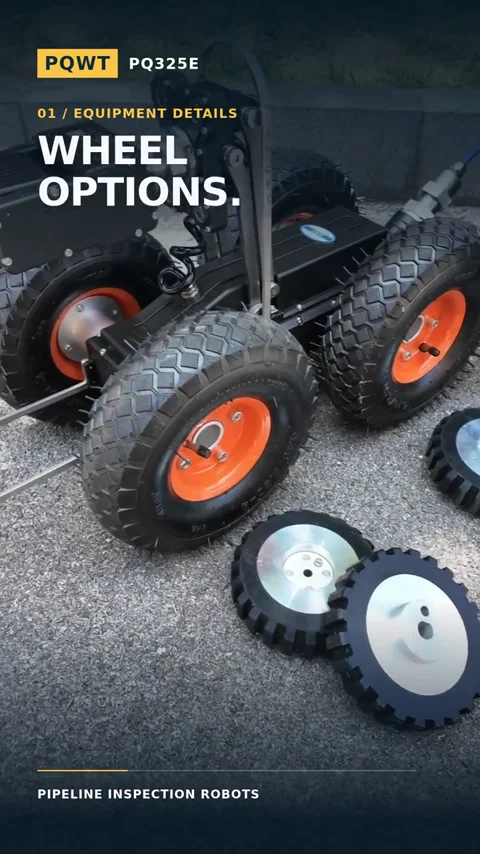
PQ325E: From Wheel Options to the Inspection Screen
Watch PQ325E wheel options, equipment details, controller handling and pipe-interior imagery. Use this English product demonstration to discuss the crawler configuration, reporting needs and delivery quotation for your project.
View product →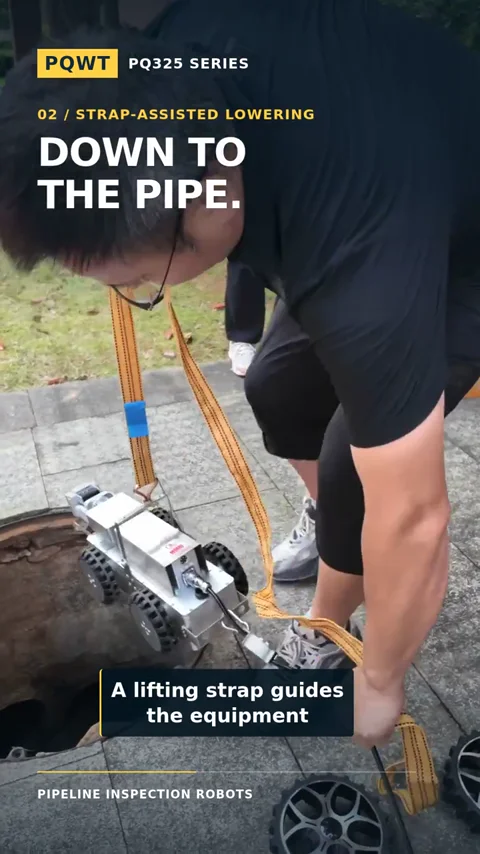
PQ325 Pipeline Robot: Preparation Before Pipe Entry
See crawler preparation, cable connection, strap-assisted lowering and a pipe-interior view. Share your access opening, pipe diameter and site conditions to request a suitable PQ325 configuration.
View product →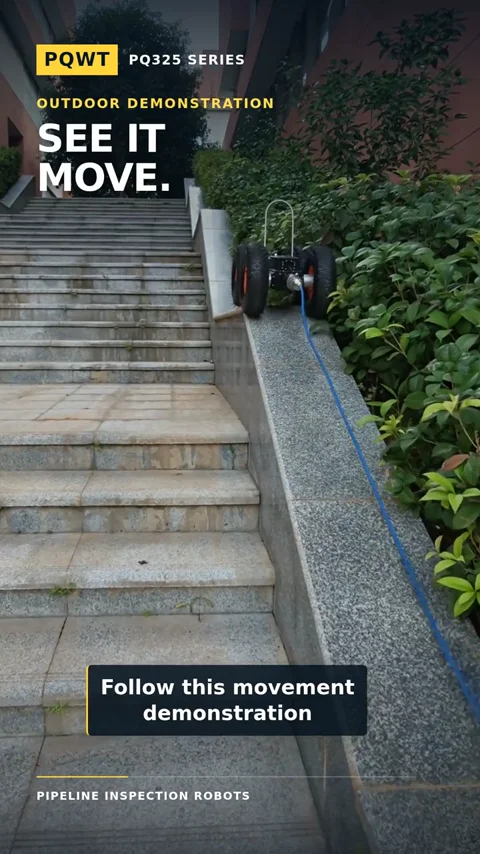
PQ325 Pipeline Robot: Wheel Setup and Outdoor Movement
Review wheel assembly, crawler movement along a sloped edge and across grass, and different wheel options. This demonstration supports configuration discussions; it does not establish rated climbing, bend or obstacle limits.
View product →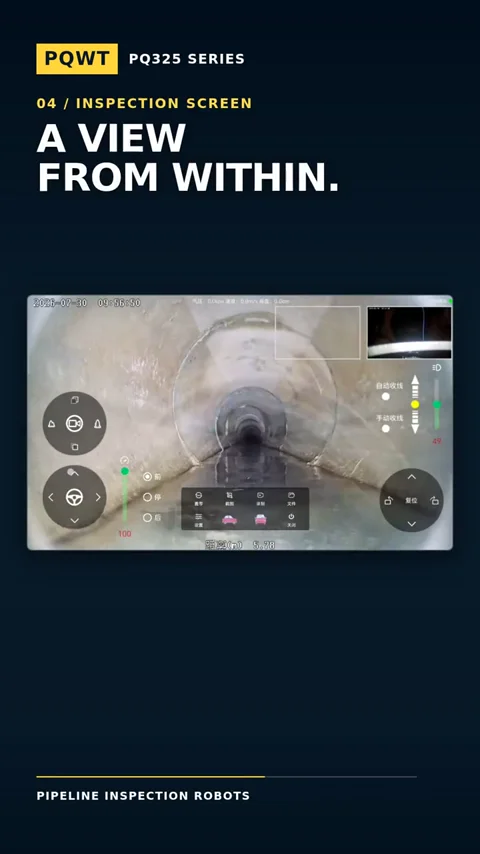
PQ325 Pipeline Inspection Workflow: Setup to Retrieval
Follow cable connection, lowering, the inspection screen and strap-assisted retrieval in this English PQ325 demonstration. Discuss access, cable handling and required inspection records before requesting a quotation.
View product →A practical CCTV pipeline inspection workflow
Review the job and hazards
Confirm pipe use, isolation status, diameter, access, atmosphere, flow, contamination, expected obstacles and the inspection objective.
Inspect every connection
Check crawler, wheels, camera, lights, cable, reel, control terminal and power supply before moving toward the manhole.
Run a dry ground test
On flat, dry ground, verify steering, forward and reverse travel, camera movement, lighting, video, snapshots and distance recording.
Lower the crawler safely
Use the specified lowering method and keep personnel clear of pinch points, traffic and the manhole edge. Do not suspend the robot by an unsuitable cable or connector.
Record a controlled outbound survey
Move at a speed that preserves a stable image. Pause at defects, rotate or lift the camera where supported and record distance-linked evidence.
Return and verify retrieval
Monitor cable tension and crawler response during return. Stop if the robot snags, loses traction or the cable behaves abnormally.
Clean, review and report
Clean the crawler according to the manual, back up the original files and prepare a defect log with distance, image, severity note and recommended follow-up.
What can a CCTV sewer robot document?
| Visible condition | What the inspection record can show |
|---|---|
| Cracks and fractures | Location, orientation, visible width and whether surrounding deformation or infiltration is present |
| Joint displacement | Offset, gap, intrusion and the effect on crawler passage or flow |
| Roots and foreign objects | Extent of intrusion and the approximate section requiring cleaning or repair |
| Sediment and deposits | Coverage, approximate depth and whether deposits restrict the view or robot movement |
| Corrosion or surface loss | Visible deterioration requiring engineering review or a more specialized test |
| Deformation and collapse | Shape change, obstruction and whether continued travel is unsafe |
| Infiltration or active flow | Visible entry point under the conditions present during the inspection |
Power-station and field-safety requirements
- Keep the 220 V portable power station dry, above ground, ventilated and away from the manhole, water and wet surfaces.
- Use only the approved charger, adapter and connection method supplied for the equipment.
- Keep the total connected AC load within the published 500 W limit for the referenced power-station setup.
- Complete the full steering, camera, lighting, recording and reel test on flat, dry ground before inserting the crawler.
- Stop operation immediately if there is smoke, a burning smell, overheating, abnormal noise, electrical leakage or damaged insulation.
- Treat every manhole and sewer as a potential confined-space, toxic-gas, fall, traffic and biological hazard. Follow local safety rules and do not enter without a compliant confined-space system.
- Do not pull, lift or recover the crawler through a connector, camera head or cable arrangement that is not designed for that load.
What a pipeline robot cannot establish by video alone
- The crawler shows visible internal conditions; it does not measure hidden wall thickness or structural capacity unless a separate compatible sensor and method are used.
- Dirty water, heavy silt, grease, steam, poor lighting or a contaminated lens can hide defects even when the camera is working correctly.
- A visible crack does not automatically determine the repair method. Severity classification may require an engineer, local coding standard or additional tests.
- The robot cannot safely pass a collapse, severe offset, tight bend or submerged section merely because the nominal diameter meets the model range.
- Inspection distance depends on the supplied cable, route geometry, traction, obstacles and retrieval conditions; confirm the exact configuration before contracting the work.
What files and reports should a CCTV inspection package deliver?
Define the evidence your client needs before comparing camera resolution or equipment price. Ask to review files produced by the actual controller and software proposed in the quotation.
A CCTV crawler documents visible pipe condition. Wall-thickness measurements, automatic AI defect grading and structural-capacity assessment are separate requirements. They must not be inferred from a high-resolution camera or a general report function.
| Required output | Evidence to request before ordering |
|---|---|
| Usable inspection video | A sample recording, supported file format, export method and playback on your intended computer |
| Defect photographs and positions | Sample snapshots, distance-overlay behavior, distance-counter setup and how section identifiers are recorded |
| Client-ready inspection report | A report sample and confirmation of which annotations are entered by the operator |
| PACP / EN 13508-2 or another coding standard | A written compatibility response against the specified standard and report template; support is not assumed |
| Wall-thickness data or AI grading | Separate confirmation of a suitable measurement system or software; ordinary CCTV footage alone does not provide these results |
| Complete delivered system | Itemized crawler, wheel sets, camera, cable, reel, controller, power equipment, training, spares, shipping and warranty terms |
Send these details for a PQ325 recommendation and quotation
| Project information | Why it is needed |
|---|---|
| Minimum and maximum internal diameter | Determines crawler clearance and wheel options |
| Pipe material and use | Provides operating, cleaning and contamination context |
| Inspection distance | Defines cable and reel requirements |
| Water depth, silt and deposits | Shows whether the camera view and traction may be restricted |
| Bends, steps and known obstacles | Supports mobility and obstacle-crossing selection |
| Access-point photos and opening size | Checks safe lowering and retrieval clearance |
| Camera and reporting requirements | Confirms fixed, adjustable or dual-camera needs plus recording output |
| Country, quantity and training language | Allows packing, support, warranty and export quotation confirmation |
Frequently asked questions
How do I get a CCTV sewer inspection robot quotation?+
Send the country, quantity, minimum and maximum internal pipe diameter, inspection distance and water or silt conditions. Choose a model or ask for a recommendation. Add access, bends, reel and reporting requirements when known; the complete configuration and shipping are confirmed in the quotation.
Does PQ325 automatically measure pipe wall thickness or include PACP reporting?+
CCTV video shows visible internal condition; it is not a wall-thickness measurement. Confirm any specialist sensor, AI grading, report format or PACP / EN 13508-2 compatibility separately for the quoted configuration.
What pipe diameter can a CCTV pipeline inspection robot enter?+
It depends on the crawler body, wheel set and real internal clearance. The PQ325 model families begin at different published diameters, from about 110 mm for A/A+ to larger municipal configurations. Deposits, deformation and joints must also be considered.
What is the difference between a manual and electric cable reel?+
A manual reel requires the operator to manage take-up directly. An electric reel reduces repetitive winding effort and can improve cable management on longer or frequent inspections, but the operator must still control tension and watch for snags.
Do I need a dual-camera sewer robot?+
A dual-camera or adjustable-camera system is useful when the project needs broader visual coverage, controllable viewing angles or larger-pipe inspection. A fixed front-view crawler may be sufficient for smaller, straighter screening work.
Can the robot inspect a pipe with standing water?+
Some crawlers are designed for wet pipe environments, but usable video and traction depend on water depth, flow, turbidity, silt and wheel configuration. Send site conditions before model selection.
Can a pipeline robot produce inspection reports?+
Depending on the supplied control and software configuration, the workflow may include video, photographs, distance marks, notes and report output. Confirm the exact reporting functions and file formats in the quotation.
Does a higher camera resolution guarantee a better inspection?+
No. Resolution helps, but lens cleanliness, lighting, stability, viewing angle, travel speed, water clarity and operator technique determine whether the footage is useful.
PROJECT REVIEW & MODEL SELECTION
Request a PQ325 pipeline robot configuration review
Send the real pipe diameter, material, inspection distance, water and silt conditions, bends, access photos, camera requirement, destination and quantity. We will compare the suitable crawler, wheel, camera and cable-reel configuration and confirm the current quotation.
I already own a device: after-sales support