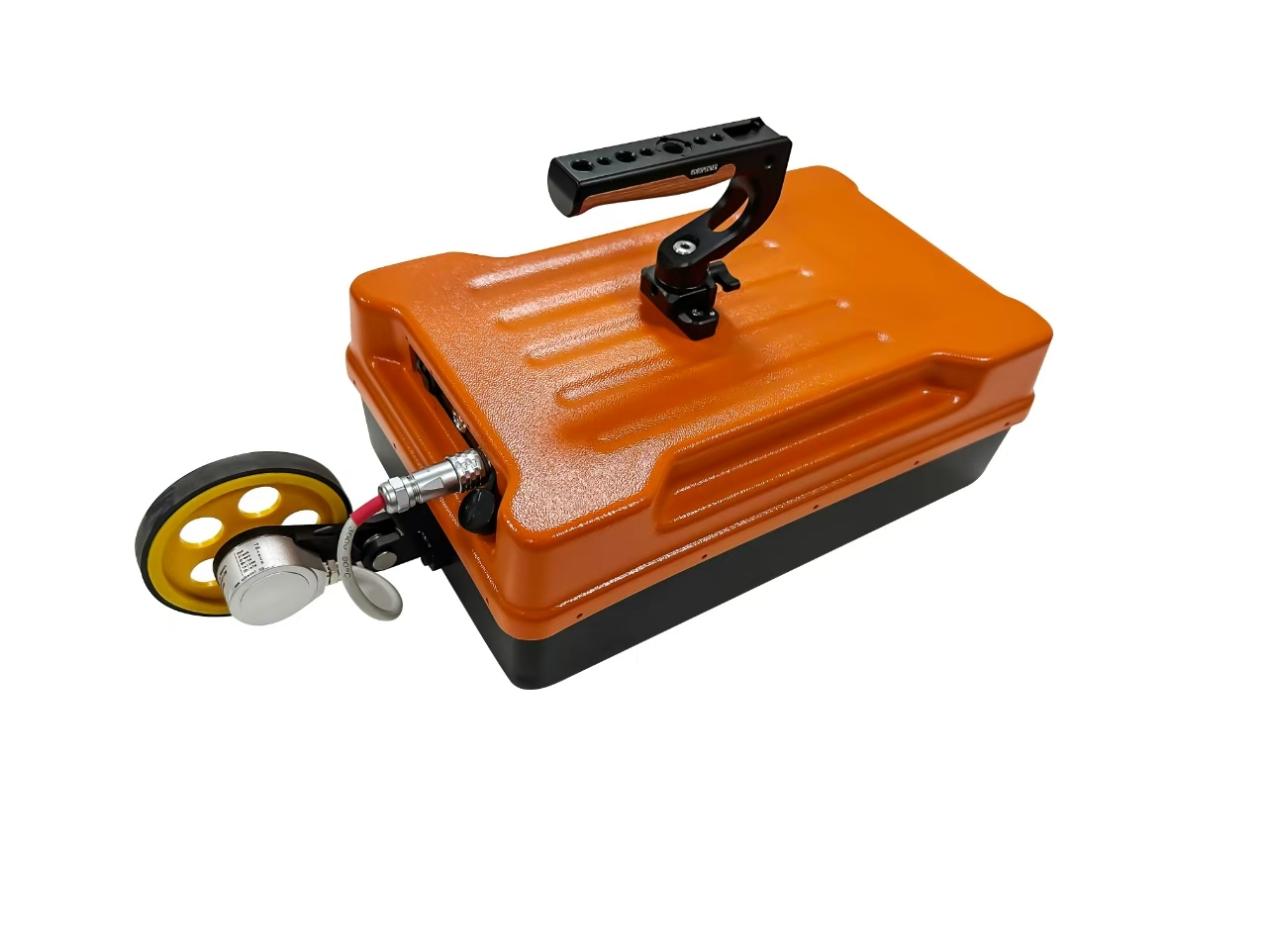
Choose PQ622A (600 MHz) or PQ622B (900 MHz) for shallow structural detail; compare PQ625 dual-frequency pairs for mixed utility, road and engineering tasks; consider PQ626C (50 MHz) or PQ626D (100 MHz) for larger geological targets where lower-frequency work is appropriate. Useful depth is site-dependent, particularly in conductive clay, saline or wet ground. Confirm the exact model suffix, antenna, accessories and deliverables on the quotation.
Ground-penetrating radar (GPR) records reflections from contrasts in electromagnetic properties. It can help investigate pavement layers, tunnel lining, buried services, voids and geological boundaries. It does not produce a literal underground photograph or automatically identify the material of every anomaly.
A practical purchase decision begins with the smallest target you need to resolve, the likely burial depth, soil or concrete conditions, site access and the form of evidence your client needs. The comparison below uses published PQWT model frequencies; it does not promise a fixed detection depth or accuracy at every site.
PQ622 vs PQ625 vs PQ626: which radar fits your project?
PQ625 single-frequency configurations are documented separately; do not assume a product called simply ‘PQ625’ includes two antennas. The supplied model suffix and frequency must appear in the final quotation and packing list.
| Family and published model | Antenna frequency | First application to evaluate | Selection check |
|---|---|---|---|
| PQ622A / PQ622B | 600 / 900 MHz respectively | Shallow road, bridge and tunnel-lining detail | Confirm target size, reinforcement and access |
| PQ625A+ / B+ | 100 + 400 / 200 + 400 MHz | Mixed-depth engineering or utility surveys | Confirm the actual antenna pair and survey method |
| PQ625C+ / D+ | 200 + 600 / 400 + 900 MHz | Utility and structural work requiring different scales of detail | Check target depth against high-frequency resolution |
| PQ626C / PQ626D | 50 / 100 MHz respectively | Larger geological targets in suitable ground | Allow space for unshielded antenna operation |
How antenna frequency affects resolution and useful depth
Higher frequencies generally resolve smaller, shallower features better; lower frequencies can offer more penetration but less fine detail. This trade-off does not turn a nominal frequency into a reliable universal depth rating. The useful profile depends on target contrast, dimensions, antenna coupling and background interference.
Conductive clay and saline pore water attenuate radar waves. Reinforcement, closely spaced utilities and rough surfaces can complicate interpretation. Before committing to a large project, ask for a trial line or a known-target demonstration on representative ground. Depth estimates also depend on a checked radar velocity or dielectric assumption.
Start from the job, then shortlist an antenna
For groundwater well siting, a GPR reflection is not proof of a productive aquifer. For a pressurized pipeline leak, GPR may help map the route or surrounding voids, but pressure, flow, acoustics, correlation or tracer gas should confirm the leak.
PQ622
Consider 600 or 900 MHz for shallow layer or reinforcement-related detail; check minimum defect dimensions and concrete conditions.
PQ625
Compare the exact dual-frequency pair where buried pipes, trenches, roads and mixed target sizes must be surveyed.
PQ626
Assess 50 or 100 MHz unshielded configurations for larger subsurface features, subject to ground conductivity and survey space.
A defensible GPR field and interpretation workflow
- Define the engineering question, smallest target, expected depth, material and available reference information.
- Inspect ground, access, reinforcement, utilities and possible interference; choose a suitable model and antenna.
- Mark parallel and crossing survey lines and a known reference target where possible.
- Record acquisition settings, distance or location measurements, calibration assumptions and site conditions.
- Review raw profiles alongside filtered views; distinguish repeatable reflections from artifacts and alternative explanations.
- Verify consequential interpretations with plans, another geophysical method, exposure, coring or a relevant field test.
Send these details to receive an accurate GPR recommendation
The manufacturer describes a Windows-based GPR Platform with DZT file support, profile views, gain and filtering. Confirm the exact supplied software version, compatible computer and accessories for your selected model.
- Country and project type: road, bridge, tunnel, utility route, void or geological investigation.
- Target material, minimum size, expected depth and required resolution.
- Ground type and moisture/salinity; concrete thickness and reinforcement where relevant.
- Survey area, line length, access width, terrain and distance-measurement needs.
- Required outputs: raw radar files, annotated profiles, coordinates, training and reporting format.
- Exact model suffix, antenna frequency, software license, computer, accessories, warranty and destination on the formal quotation.
Sources and editorial note
Written as an original technical guide using the source material below. Product suitability and field results still depend on site conditions, operator technique and independent verification.
Frequently asked questions
What is the difference between PQ622, PQ625 and PQ626?+
PQ622 uses 600 or 900 MHz configurations for shallow structural detail. PQ625 has several exact single- and dual-frequency options for mixed engineering tasks. PQ626C and PQ626D are 50 and 100 MHz unshielded configurations for larger targets where suitable.
Does a lower-frequency antenna always detect deeper?+
No. Lower frequency trades fine resolution for possible penetration, but conductivity, salinity, moisture, target size and interference may sharply limit useful depth.
Can GPR identify a water-filled pipe or leak with certainty?+
No. A reflection indicates an electromagnetic contrast, not a unique material identification or confirmed pipe opening. Corroborate route and leak findings with plans and leak-specific tests.
What should I request with a PQWT GPR quotation?+
Ask for the full model suffix, antenna frequency or pair, software version, compatible computer, distance-measurement equipment, accessories, training, warranty and delivery terms.
PROJECT REVIEW & MODEL SELECTION
Request a project-specific GPR configuration
Send the target, expected depth, ground conditions, survey size and destination. We can confirm an exact antenna configuration and accessories in the quotation.