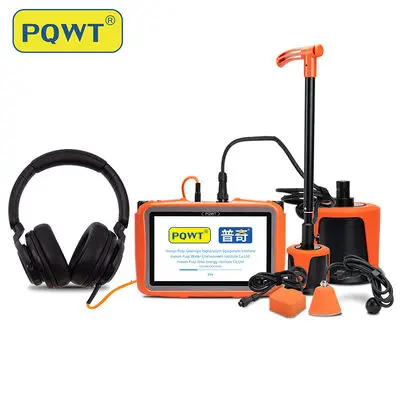
Shortlist an underground pipeline leak detector only after recording the pipe material, diameter, operating pressure, burial depth, route length, surface, access points and background noise. Acoustic equipment is strongest when a pressurized leak creates vibration that reaches a stable sensor contact; difficult plastic, deep, low-pressure or noisy sites may need tracer gas, correlation or pressure testing as a complementary method.
Leak detectors do not all solve the same job. A compact indoor instrument, a professional spectrum-analysis unit and a multi-sensor outdoor kit can all be useful, but in different environments.
Use the selection sequence below before requesting a price. It reduces the risk of buying more equipment than necessary—or choosing a configuration that cannot make stable contact on the actual route.
Start with eight project facts
| Project fact | Why it matters |
|---|---|
| Pipe material | Metal usually transmits leak sound farther than PVC, PPR, PE or HDPE |
| Diameter | Large mains and small service lines create different access and listening conditions |
| Operating pressure | Higher pressure often creates more acoustic energy; zero-pressure leaks need another approach |
| Burial depth | Depth and backfill attenuate the signal between the pipe and surface |
| Pipeline length | Long routes may require faster screening or section isolation before pinpointing |
| Surface | Tile, concrete, asphalt, soil and grass require different sensor contact |
| Route and access | Known fittings and valves provide useful contact points; an unknown route may need a locator |
| Background noise | Traffic, pumps, HVAC and electrical equipment can mask or imitate a leak |
Estimate whether acoustic evidence will be strong or weak
Rigid pipe + useful pressure
Metal, firm contact and a pressurized leak often provide clearer vibration.
Plastic + low pressure
Flexible pipe, small leakage and low pressure may reduce the usable sound range.
Deep or soft cover
Loose soil, insulation and thick construction layers absorb energy.
Noisy environment
Repeat at a quieter time or use filtering and control points before accepting a peak.
Match the detection method to the failure condition
| Method | Useful when | Important limitation |
|---|---|---|
| Acoustic listening | The pipe is pressurized and leak sound reaches contact or ground sensors | Weak on some plastic, deep, low-pressure or noisy routes |
| Spectrum / filter analysis | A professional needs to compare signal character and reject parts of the noise band | Filtering supports interpretation; it does not prove a leak |
| Tracer gas | A small leak or plastic route has weak acoustic transmission | Requires safe gas procedure, suitable access and controlled interpretation |
| Pipeline locating | The route is unknown | Locates the utility, not the leak itself |
| Pressure test | A section must be confirmed as leaking | Confirms loss in a section but may not pinpoint the position |
A practical PQWT shortlist
| Model | Best starting point | Main workflow | Choose it when |
|---|---|---|---|
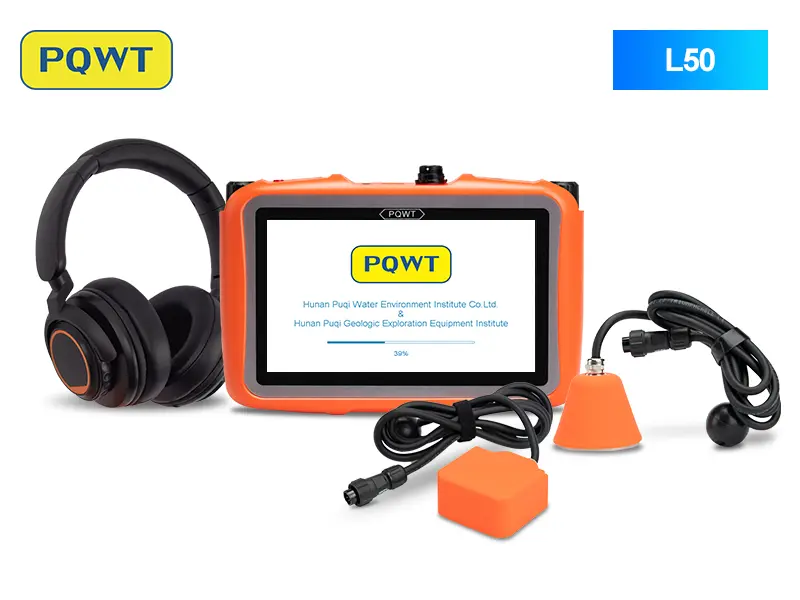
| PQWT-L50 | Indoor concealed pipes | Triangular + square sensors; general screening and locating | Floors, walls, kitchens, bathrooms and compact building work |
| PQWT-CL200 | Professional network analysis | 1–5,000 Hz spectrum, selectable center frequencies, filtering and recording | The operator needs detailed acoustic comparison and documentation |
| PQWT-L5000 | Indoor + outdoor work | Three sensors; general detection and locating | One kit must cover building pipes and outdoor routes |
| PQWT-L7000 | Broader multi-sensor field work | Four sensors including a larger noise-reduction option | Sites vary widely or background noise requires more sensor choices |
Evaluate a demonstration with control points
A fair demonstration shows both useful evidence and limitations. Avoid treating a single strong reading, a colorful spectrum or a wet surface as automatic proof.
- Ask the operator to state the pipe route, material, pressure and settings before testing.
- Include a known non-leaking control area rather than showing only the suspected point.
- Repeat the same point after moving away and returning.
- Change one condition at a time and explain why the result changes.
- Verify the repair and record whether the acoustic indication disappeared.
Send complete project information with the quotation request
These details allow a meaningful model recommendation and a formal quotation covering sensors, accessories, warranty, training, shipping and current export price.
- Country and delivery city
- Model being considered
- Pipe material and diameter
- Burial or concealment depth
- Operating pressure and pipeline length
- Indoor/outdoor surface and noise conditions
- Known route, symptoms, quantity and training language
Frequently asked questions
What is the best detector for an underground plastic pipe?+
There is no universal model. Confirm pressure, depth, material, diameter, surface and access. Acoustic listening may work, but difficult PVC, PPR, PE or HDPE leaks may need tracer gas or pressure testing.
Do more sensors always mean better leak detection?+
No. More sensors provide more contact options, but the correct surface coupling, repeatable workflow and suitable method matter more than sensor count alone.
Can an acoustic detector locate a leak when the pipe has no pressure?+
Usually acoustic performance is poor without escaping water under pressure. Section isolation, pressure testing, tracer gas or another method may be needed.
Should I choose L5000 or L7000?+
L5000 is a three-sensor indoor/outdoor kit. L7000 adds a fourth, larger sensor option for broader field conditions and noise reduction. Choose from the real site, not the model number.
What information should I send for model selection?+
Send country, pipe material, diameter, pressure, burial depth, length, surface, route access, noise, symptoms and required quantity.
PROJECT REVIEW & MODEL SELECTION
Get a project-based leak detector recommendation
Send the model, country, pipe material, diameter, burial depth, pressure, pipeline length and site conditions. We will compare L50, CL200, L5000, L7000 and complementary methods.