Choose CL200 when detailed spectrum, filtering, recording and frequency selection are central to the operator’s workflow. Choose L5000 when one three-sensor kit must cover concealed indoor pipes and buried outdoor routes. Choose L7000 when the same mixed environment benefits from a fourth, larger sensor option for wider surface and noise conditions.
All three models are acoustic instruments for pressurized pipeline inspection, but they organize field work differently. The correct choice depends on the operator, contact surface, pipe and noise—not simply the highest model number.
The specifications below are selection references. The final packing list, accessories and warranty terms should be confirmed in the formal quotation.
CL200, L5000 and L7000 side by side
| Feature | PQWT-CL200 | PQWT-L5000 | PQWT-L7000 |
|---|---|---|---|
| Primary emphasis | Professional acoustic analysis and documentation | Multi-sensor indoor/outdoor locating | Expanded multi-sensor indoor/outdoor locating |
| Frequency information | 1–5,000 Hz spectrum; 31 center frequencies | 1–10,000 Hz | 1–10,000 Hz |
| Display / workflow | 7-inch touch display; spectrum, filtering, curves, recording/playback | 7-inch touch display; General Detection + Locating | Touch display; General Detection + Locating |
| Sensor arrangement | Professional acoustic sensor configuration confirmed by quotation | Three sensors: horizontal, vertical and medium | Four sensors: horizontal, vertical, medium and large |
| Listed working depth | Up to 2 m in current model listing; site dependent | Up to 5 m in current model listing; site dependent | Up to 5 m in current model listing; site dependent |
| Best starting point | Technicians who want detailed frequency control and records | Mixed indoor and outdoor inspection | Mixed sites needing the broadest contact and noise options |
| Warranty | 2 years | 2 years | 2 years |
Choose CL200 for analysis-led professional inspection
CL200 is the strongest fit when the technician wants selectable frequency tools, filtering, spectrum visualization, time/noise comparison and recording or playback for documentation. It suits water-supply, heating, property and municipal maintenance teams that already understand comparative acoustic inspection.
- 31 center frequencies and common filter bands
- 1–5,000 Hz spectrum analysis
- Gain listed up to 100 dB
- Recording, storage and playback for review
- Useful when the operator must explain why one sound differs from a nearby control
Choose L5000 for a clear three-sensor indoor/outdoor workflow
L5000 packages three contact options for typical building floors, confined wall or cabinet work and outdoor surface listening. General Detection supports route screening; Locating mode supports closer point-to-point comparison.
- Indoor concealed pipes and outdoor buried service lines
- Horizontal, vertical and medium sensor configuration
- 1–10,000 Hz listed range
- Result-picture export and up to 15 hours listed working time
- Practical choice when one team moves regularly between buildings and outdoor networks
Choose L7000 when an additional large sensor is useful
L7000 extends the mixed indoor/outdoor concept with four sensor types. The larger sensor is intended to improve coupling and noise reduction on demanding outdoor sites. It does not remove the need for control points, repeat measurements or verification.
- Horizontal, vertical, medium and large sensors
- Broad indoor/outdoor pressure-pipe workflow
- 1–10,000 Hz listed range
- Useful when surfaces and background-noise conditions vary across projects
- A stronger field kit when the extra sensor has a defined job
Select by scenario, not by model number
| Scenario | Starting model | Reason |
|---|---|---|
| Professional technician needs spectrum records | CL200 | Frequency control, curve analysis and recording are central |
| Hotel or facility team covers rooms and outdoor service lines | L5000 | Three-sensor kit covers common indoor/outdoor contacts |
| Municipal contractor encounters asphalt, soil and noisy roads | L7000 | Fourth large sensor broadens field coupling and noise options |
| Only shallow floors and walls are inspected | Consider L50 | A compact indoor kit may be more economical and easier to train |
| Deep plastic pipe with weak pressure | Consider complementary method | Tracer gas or pressure testing may be more reliable than acoustic-only work |
Quotation checklist for an accurate recommendation
- Country and delivery city
- Preferred model or models to compare
- Pipe material, diameter and pressure
- Burial or concealment depth
- Pipeline length and route knowledge
- Indoor/outdoor surface and background noise
- Required quantity, training language and intended operator
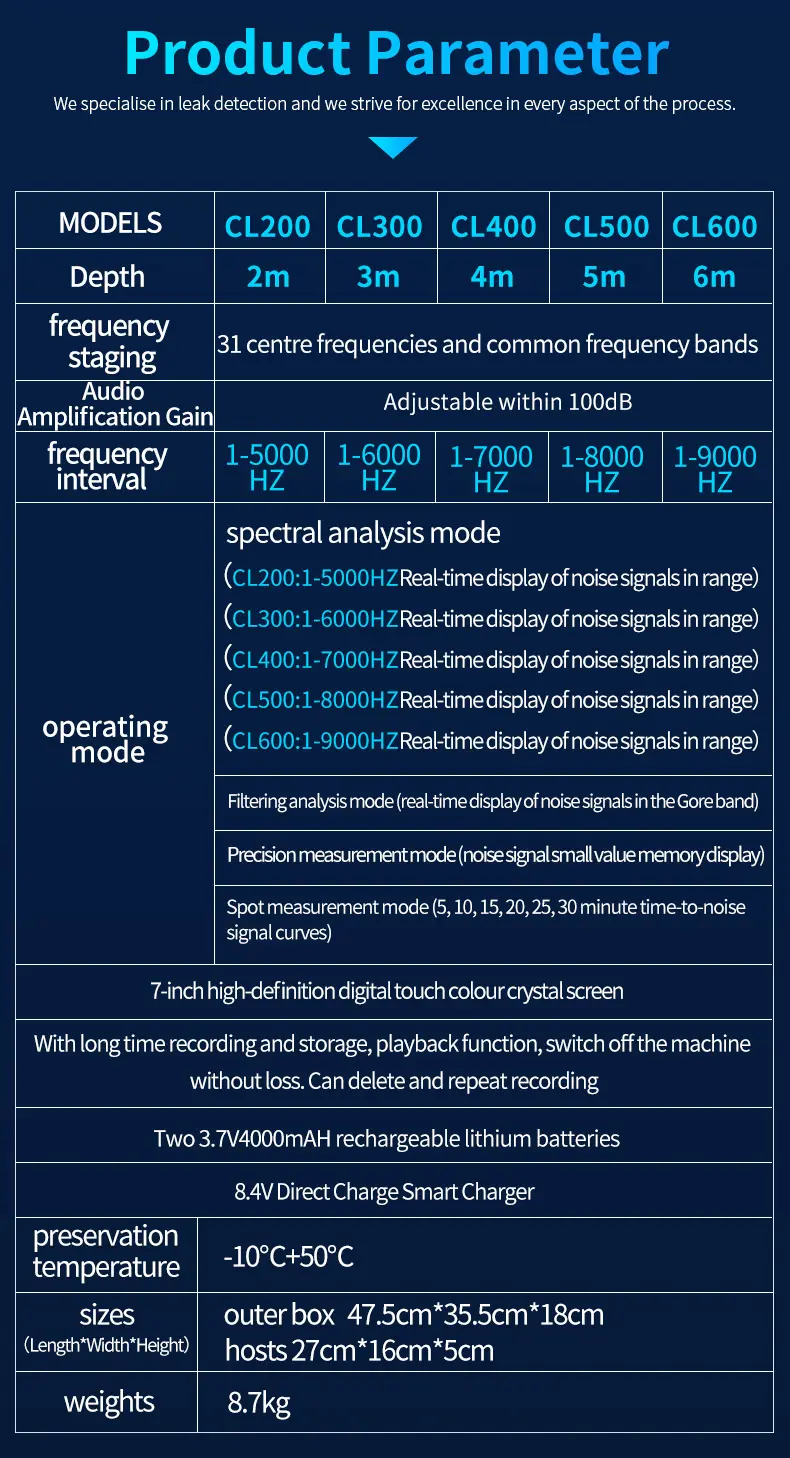
Professional spectrum-analysis detector
For frequency-led inspection, filtering, recording and documented comparison.
View product →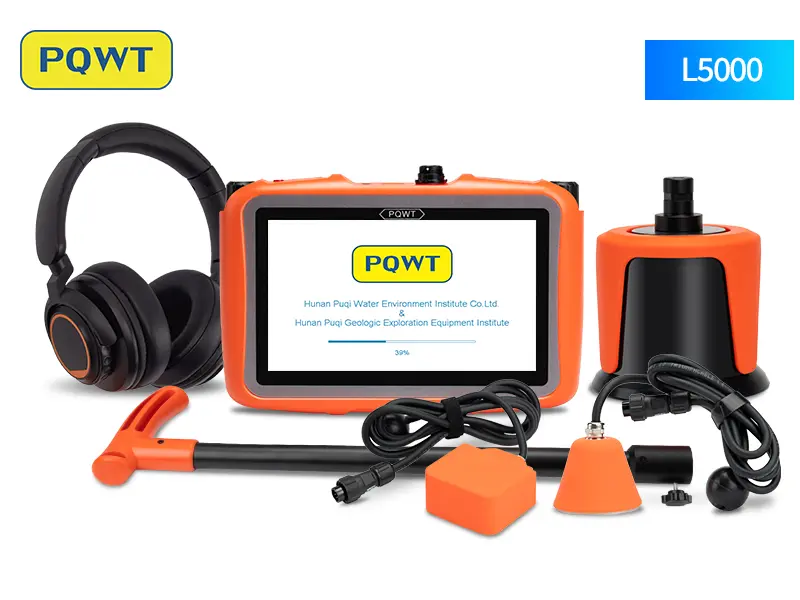
Three-sensor indoor/outdoor detector
For building pipes, buried routes and a consistent multi-sensor workflow.
View product →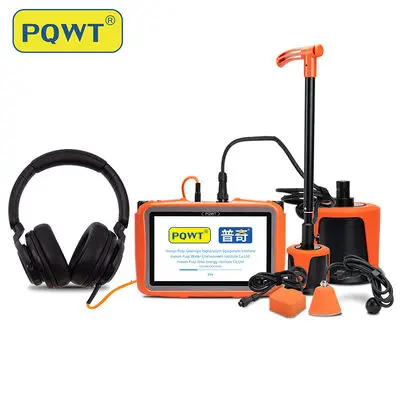
Four-sensor field detector
For varied surfaces and projects where the large sensor has a clear role.
View product →Frequently asked questions
What is the main difference between CL200 and L5000?+
CL200 emphasizes detailed frequency analysis, filtering and recording. L5000 emphasizes a three-sensor indoor/outdoor General Detection and Locating workflow.
What does L7000 add over L5000?+
L7000 adds a fourth, larger sensor option intended for broader outdoor coupling and noise reduction. Choose it only when that added contact option matches the project.
Which model is best for plastic pipes?+
No acoustic model guarantees results on plastic. Pressure, leak size, depth and soil matter. Provide project details and consider tracer gas or pressure testing for weak-signal sites.
Can these detectors identify the exact leak point automatically?+
No. They support comparative acoustic inspection. The operator must narrow, repeat and verify a probable zone before repair.
Do all three models have a two-year warranty?+
The standard listed warranty is two years. Exact warranty terms, package and accessories are confirmed in the formal quotation.
PROJECT REVIEW & MODEL SELECTION
Compare CL200, L5000 and L7000 for your actual pipeline
Send the country, pipe material, diameter, pressure, depth, length, surface and noise. We will recommend the suitable model and prepare an exact export quotation.